
Making design feedback actionable in Figma with an AI agent
Reimagined Figma comments to centralize cross-channel feedback, surface priorities, and accelerate collaboration for design teams.

This was a 4 day design assignment for a Product design role focused on re-designing any feature with an AI agent and working with existing design systems.
A DESIGNER'S WORKFLOW
This is what my Figma comments look like after a review.
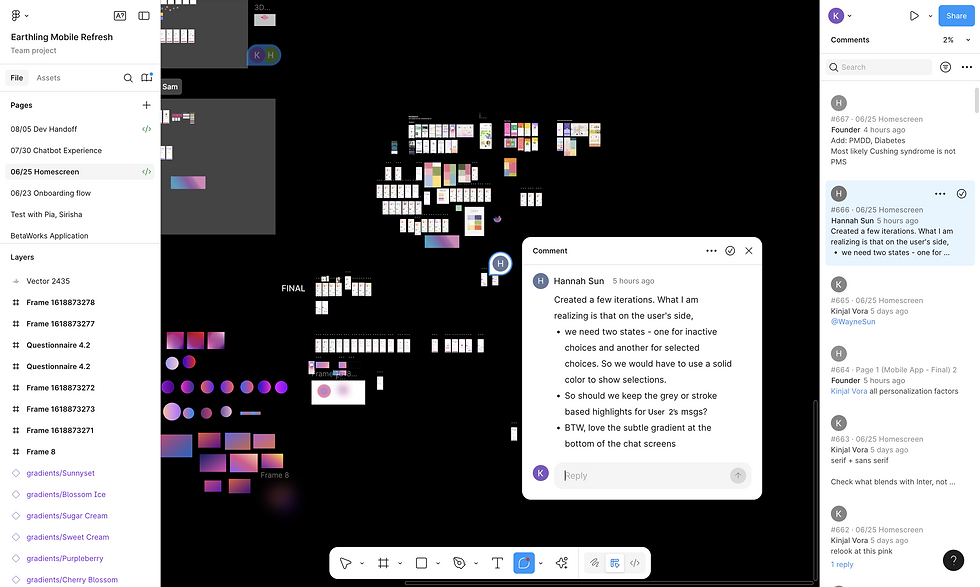
Messy threads. Decisions hidden. Notes to myself.
And the important feedback? In Slack.

Or Zoom. Or someone’s Google doc


By morning, I’m piecing together a puzzle...
What did we actually decide?
Where do I even start?
THE CONTEXT
Figma’s comment feature is already strong at
"capturing conversations"
It has a Centralized sidebar with sorting and search

& contextual tagging on screens that keeps feedback tied to design elements

In startups, feedback is often fast & unorganized

while in enterprises,

it’s also high-volume & cross-departmental
& scattered across


But real workflows quickly expose its limits...
In both cases,
It is weak at organizing feedback in a way that
facilitates action
THE NEED
As a result...
Comments aren’t just “comments.”
Design teams adapted and stretched them to do five jobs:
to mark decisions
to mark decisions
to request changes
to request changes
as notes to self
as notes to self
to tag teammates
to tag teammates
for async discussions
for async discussions
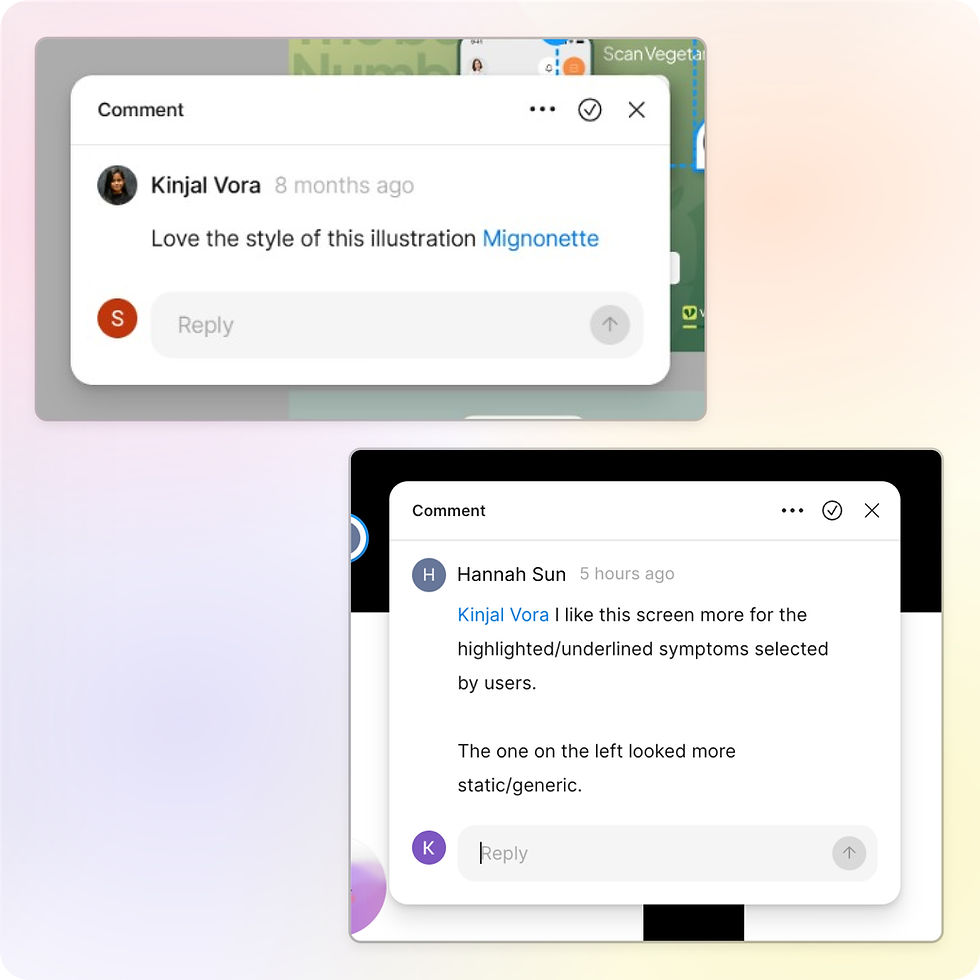


And sometimes, all of that is buried in the same thread
And sometimes, all of that is buried in the same thread

This signals an unmet need🚦
A system that accelerates taking action on the feedback
THE OPPORTUNITY
Figma comments are already being used as a workflow management system —

So what if an AI agent ✨ could step in?
Not to design for us,
But to act as the
"feedback orchestrator"
helping designers move faster, without losing control
by
AI AGENT ACTIONS
FOR THESE USER NEEDS
pulling feedback in one place
WHEN feedback is scattered across Slack, Zoom, Notion, and Figma, I WANT it centralized, SO THAT I don’t waste time chasing comments across tools.
organizing it
WHEN I’m overwhelmed by lots of feedback, I WANT it organised, SO THAT I can process them faster.
extracting actionables
WHEN the feedback is messy, I WANT clear requests surfaced, SO THAT I don’t miss anything important.
identifying themes & patterns
WHEN multiple stakeholders repeat similar points, I WANT I want recurring themes highlighted, SO THAT I can understand the bigger picture.
letting designers query it seamlessly
WHEN I need to recall past decisions or feedback, I WANT to search easily, SO THAT I can quickly find context without digging through threads
COULD THIS
BE DONE WITHOUT AI?
hover
NO.
Manual systems can’t pull from multiple platforms, understand semantic context, or identify patterns across time, tools, and people.
That’s where an AI agent is uniquely valuable.
IDEATION
With that brief in mind, I asked myself:
💭 If I opened Figma the morning after a design review,
what would make the day faster and clearer?
This framing guided every design decision to create a
seamless, transparent, focused, flexible & proactive
agentic UX.


THE SOLUTION
Figma Feedback — a design critique workflow management layer
that mirrors a designer’s natural workflow, eliminating busy work & accelerating action.

The AI agent pulls relevant feedback from different tools only when designers opt in, so that the experience is seamless, without compromising agency.

Once imported, feedback is grouped by type, stakeholder, and context, keeping it scannable, reducing cognitive load.

The AI agent only surfaces the summarised version of actionables for a focused view, each linked to context for transparency.
Designers can toggle between a concise or expanded view for flexibility.

The agent understands intent and acts on it,
as seamless and proactive as collaborating with a co-worker.

For design teams
A searchable knowledge layer
It will capture historical design decisions in context, improving alignment with stakeholders and ease onboarding.
Also, faster iteration cycles & reduced cogntive load.
PROJECTED IMPACT
Designing around real user needs showed me how thoughtful systems design can ripple outward
For Figma

Stronger competitive differentiation as a collaborative design tool
with strengthened user retention and enterprise upsell opportunities, especially for large teams where cross-functional collaboration and decision traceability are critical.
REFLECTION
The turning point for me was thinking in systems and workflows, not just features.
Once framed that way, the hidden workarounds in comments revealed the need for post-design critique workflow management. Also, as AI agents become ever-present, it will be crucial for us to design seamless experiences while preserving human agency.


.png)